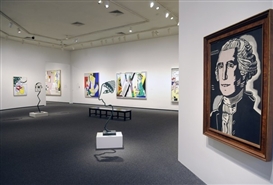
Roy Lichtenstein’s career</a> since his death in 1997, aims to offer a new, scholarly assessment of the work of this foremost Pop artist. <a target="_blank" href=https://www.mutualart.com/Exhibition/Roy-Lichtenstein--A-Retrospective/"/Artist/Roy-Lichtenstein/1D75C7E9A1F23527">Lichtenstein is an artist whose work is widely known, reproduced, copied, and parodied—he is an artist that we seem to know well but in fact the true diversity and complexity of his oeuvre is little understood. Presenting over 130 paintings and sculptures, as well as over 30 little- or never-before-seen drawings and collages, this exhibition gives full consideration to all periods of Lichtenstein’s career, including but not limited to, pre-Pop expressionist work, classic Pop Romance and War cartoon paintings, Mirrors, Brushstrokes, Explosions, Artist's Studio paintings, late nudes, and Chinese Landscapes. Special consideration is given to Lichtenstein’s relationship to art historical sources, ranging from Picasso and Cubism through Surrealism, Futurism, German Expressionism, and the American West. Finally, the exhibition offers an examination of the artist’s use of alternative media like Plexiglas, Rowlux, and perforated steel in an attempt to broaden the understanding of his art beyond the strictly canonical early Pop paintings. <br></p>" />

Roy Lichtenstein: A Retrospective

May 16, 2012 - Sep 03, 2012

This exhibition, the first presentation of the full scope and breadth of Roy Lichtenstein’s career since his death in 1997, aims to offer a new, scholarly assessment of the work of this foremost Pop artist. Lichtenstein is an artist whose work is widely known, reproduced, copied, and parodied—he is an artist that we seem to know well but in fact the true diversity and complexity of his oeuvre is little understood. Presenting over 130 paintings and sculptures, as well as over 30 little- or never-before-seen drawings and collages, this exhibition gives full consideration to all periods of Lichtenstein’s career, including but not limited to, pre-Pop expressionist work, classic Pop Romance and War cartoon paintings, Mirrors, Brushstrokes, Explosions, Artist's Studio paintings, late nudes, and Chinese Landscapes. Special consideration is given to Lichtenstein’s relationship to art historical sources, ranging from Picasso and Cubism through Surrealism, Futurism, German Expressionism, and the American West. Finally, the exhibition offers an examination of the artist’s use of alternative media like Plexiglas, Rowlux, and perforated steel in an attempt to broaden the understanding of his art beyond the strictly canonical early Pop paintings.
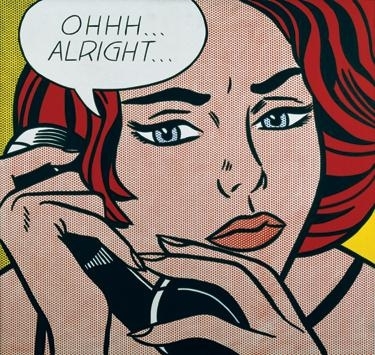

This exhibition, the first presentation of the full scope and breadth of Roy Lichtenstein’s career since his death in 1997, aims to offer a new, scholarly assessment of the work of this foremost Pop artist. Lichtenstein is an artist whose work is widely known, reproduced, copied, and parodied—he is an artist that we seem to know well but in fact the true diversity and complexity of his oeuvre is little understood. Presenting over 130 paintings and sculptures, as well as over 30 little- or never-before-seen drawings and collages, this exhibition gives full consideration to all periods of Lichtenstein’s career, including but not limited to, pre-Pop expressionist work, classic Pop Romance and War cartoon paintings, Mirrors, Brushstrokes, Explosions, Artist's Studio paintings, late nudes, and Chinese Landscapes. Special consideration is given to Lichtenstein’s relationship to art historical sources, ranging from Picasso and Cubism through Surrealism, Futurism, German Expressionism, and the American West. Finally, the exhibition offers an examination of the artist’s use of alternative media like Plexiglas, Rowlux, and perforated steel in an attempt to broaden the understanding of his art beyond the strictly canonical early Pop paintings.


Artists on show

Contact details

Sunday - Tuesday
10:30 AM - 5:00 PM
Wednesday
10:30 AM - 5:00 PM
Thursday
10:30 AM - 8:00 PM
Friday
10:30 AM - 5:00 PM
Saturday
10:30 AM - 5:00 PM
Roy Lichtenstein - Voices from the Archive
May 31, 2012
6:00 - 7:00 PM
111 South Michigan Avenue Loop - Chicago, IL, USA 60603

Related articles

Art review: ‘Roy Lichtenstein: A Retrospective’ at the National Gallery

What's on nearby

Beatriz Santiago Muñoz</a>’s 2021 film The Crow, the Trench and the Mare.</p><p>Muñoz created this film in Haiti and Puerto Rico as a meditative reflection on a fundamental metaphysical subject: human awareness of time and space. Muñoz took inspiration from a technique in Sanskrit poetry called ślesa, in which two distinct stories are narrated at once. The film tracks Haitian playwright Guy Regis Junior (born 1974) as he discusses translating the classic 20th-century novel by Marcel Proust, Remembrance of Things Past, from French into Haitian Kreyol. This account is intertwined with a monologue by Italian physicist Carlo Rovelli (born 1956) about the meaning of time and the possibility of many “nows” unfolding at once. The film hints throughout at connections between disparate places and events, as well as the ways that a linear understanding of time limits our understanding of the world’s dynamic complexities.</p><p><br></p>" />
Frida Kahlo’s work</a> for the first time in the Art Institute galleries, this exhibition focuses on the celebrated Mexican artist’s first and only trip to Europe and her brief yet pivotal encounter with Mary Reynolds, an American avant-garde bookbinder who stood at the center of a rich Parisian artistic community.</p><p>Drawing upon the extensive Mary Reynolds Collection at <a target="_blank" href=https://www.mutualart.com/Exhibition/Roy-Lichtenstein--A-Retrospective/"/Organization/The-Art-Institute-of-Chicago/A242C274A275EDCF">The Art Institute of Chicago</a> and extraordinary Kahlo loans from public and private collections in the US, Mexico, and Europe, the presentation sheds light on this little-known chapter of 20th-century art history, recounting the legacies of Kahlo and Reynolds—both artists themselves and partners of artists—as they navigated Surrealism, identity, and cross-cultural exchange on the eve of World War II.</p><p>Kahlo traveled to France in January 1939 at the invitation of André Breton, the architect of European Surrealism. Breton had visited Kahlo in Mexico the year previously and invited her to consider an exhibition in Paris. The French city, however, did not agree with Kahlo. She quickly found it eroding her sense of artistic freedom and her health—until she met Reynolds. When Kahlo was rushed to the hospital with a kidney infection, Reynolds invited her to convalesce at her home at 14 rue Hallé, a hub of the city’s visual and literary avant-gardes who regularly communed and dined there.</p><p>Reynolds and her partner, the artist Marcel Duchamp, treated this home as a living work of art and abundantly installed it with their own artworks and unique books, as well as paintings and sculptures by close friends, such as Constantin Brancusi, Alexander Calder, Yves Tanguy, and Jean Cocteau. This rich creative and domestic environment in many ways reflected that of Kahlo’s own beloved Casa Azul in Mexico City.</p><p>Our exhibition traces Kahlo’s artistic trajectory from her first solo exhibition to her short but highly consequential engagement with Mary Reynolds and the French Surrealists and then back across the Atlantic in 1940 with Kahlo’s participation in the International Exhibition of Surrealism in Mexico City. The story is told through approximately 100 objects, including paintings, book bindings, works on paper, photographs, and archival materials, notably letters from Kahlo to her lover, the photographer Nickolas Muray, where she recounts the experience of her Paris sojourn in her own voice.&nbsp;</p><p><br></p>" />
Kodwo Eshun</a> and <a target="_blank" href=https://www.mutualart.com/Exhibition/Roy-Lichtenstein--A-Retrospective/"/Artist/Anjalika-Sagar/DA69B724ABEA3BEE">Anjalika Sagar</a> of <a target="_blank" href=https://www.mutualart.com/Exhibition/Roy-Lichtenstein--A-Retrospective/"/Artist/The-Otolith-Group/B97F38B59EF38F6E">the Otolith Group</a> have conceived a mural that studies the films directed by Senegalese filmmakers Ousmane Sembène and Djibril Diop Mambéty between 1963 and 2003. Picture a mural that montages the spaces, bodies, faces, forms, gestures, expressions, geometries, and geographies of the cinematic Sahel imagined and invented by Mambéty and Sembène.</p><p><br></p>" />
Map View
Sign in to MutualArt.com