


Kwon Young-woo
Blum & Poe is pleased to present a survey of work by Kwon Young-woo (1926–2013), one of the founding figures of Dansaekhwa, the monochrome painting movement that redefined Korean art starting in the mid-1960s. This is Kwon’s first solo exhibition with the gallery and his first solo presentation in New York.
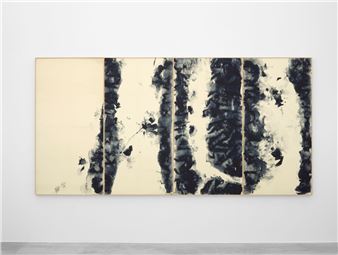
Seeking a new alternative to the ink painting traditions that dominated Korea in the 1960s, Kwon initially dispensed with the use of ink and began to scratch at the surface of the hanji paper, creating all-over compositions of rips that emphasized the primacy of the ground. During the 1970s and early 1980s he expanded his repertoire, perforating the paper from behind and tearing it into more ragged strips. Despite the implied aggression in these gestures, the works are serenely calm and meditative. Eventually Kwon reintroduced the use of color, pouring gouache and ink with absolute precision into and around the cuts to further accentuate his mark making.
A decade older than Lee Ufan and the other artists associated with Dansaekhwa, Kwon’s practice was fundamental to the development of the movement. Though the term literally translates as “monochrome painting,” it is better understood in terms of the processes the artists employed. Variously ripping paper, dragging pencils, pushing paint, and soaking canvas, the artists manipulated the materials of painting in ways that questioned the terms by which the medium was known. Promoted in Seoul, Tokyo, and Paris, Dansaekhwa quickly became the globally recognized face of contemporary Korean art.
Leading up to the opening of the exhibition, Dominique Lévy, Greene Naftali, Gallery Hyundai, and Blum & Poe will cohost a panel discussion on Dansaekhwa with artist Chung Sang-Hwa and Alexandra Munroe, Samsung Senior Curator, Asian Arts, Solomon R. Guggenheim Museum. The conversation will begin at 6:30pm on Tuesday, May 31, at Dominique Lévy Gallery. Seating is limited, please RSVP to rsvpny@blumandpoe.com.

Recommended for you

Blum & Poe is pleased to present a survey of work by Kwon Young-woo (1926–2013), one of the founding figures of Dansaekhwa, the monochrome painting movement that redefined Korean art starting in the mid-1960s. This is Kwon’s first solo exhibition with the gallery and his first solo presentation in New York.
Seeking a new alternative to the ink painting traditions that dominated Korea in the 1960s, Kwon initially dispensed with the use of ink and began to scratch at the surface of the hanji paper, creating all-over compositions of rips that emphasized the primacy of the ground. During the 1970s and early 1980s he expanded his repertoire, perforating the paper from behind and tearing it into more ragged strips. Despite the implied aggression in these gestures, the works are serenely calm and meditative. Eventually Kwon reintroduced the use of color, pouring gouache and ink with absolute precision into and around the cuts to further accentuate his mark making.
A decade older than Lee Ufan and the other artists associated with Dansaekhwa, Kwon’s practice was fundamental to the development of the movement. Though the term literally translates as “monochrome painting,” it is better understood in terms of the processes the artists employed. Variously ripping paper, dragging pencils, pushing paint, and soaking canvas, the artists manipulated the materials of painting in ways that questioned the terms by which the medium was known. Promoted in Seoul, Tokyo, and Paris, Dansaekhwa quickly became the globally recognized face of contemporary Korean art.
Leading up to the opening of the exhibition, Dominique Lévy, Greene Naftali, Gallery Hyundai, and Blum & Poe will cohost a panel discussion on Dansaekhwa with artist Chung Sang-Hwa and Alexandra Munroe, Samsung Senior Curator, Asian Arts, Solomon R. Guggenheim Museum. The conversation will begin at 6:30pm on Tuesday, May 31, at Dominique Lévy Gallery. Seating is limited, please RSVP to rsvpny@blumandpoe.com.
Artists on show
Contact details

What's on nearby


