Some Lesser-Known Works of Edvard Munch
Edvard Munch's lesser-known works reflect psychological depth and emotional intensity, often overshadowed by the fame of The Scream
Benjamin Blake Evemy / MutualArt
Dec 03, 2024
Despite the fact that The Scream is one of the world’s most famous paintings, the rest of Edvard Munch’s oeuvre remains relatively unknown outside of his more fervent followers. Which is somewhat surprising considering that many of his pieces possess the same intensity, the same fearless exploration of the fragility of the psyche, the same tortured cry into the seething void that is the human condition.
.Jpeg) Edvard Munch, Moonlight, 1893, oil on canvas, The National Gallery, Oslo
Edvard Munch, Moonlight, 1893, oil on canvas, The National Gallery, Oslo
A woman in black stands against a white picket fence, hands clasped behind her back as if waiting for a photograph to be taken, face pale in the moon’s full glow. But there is something wrong with her shadow cast. It stands inexplicably separate on the other side of the adjoining line of fence, strangely hatless head cocked to one side. On the opposite side of the subject, a mass of darkness moves like swirling flame, while in the lefthand foreground, what takes the shape of a torso moves out of frame, a blood-like substance coating tops of shoulders and blades. The inherent foreboding of the piece is intensified by the contrast formed by its more tender elements: the iris blue found spilling from the pane of the low-lit window, the roses softly blooming in the front garden. Like as with many of his motifs, Munch would go on to revisit Moonlight. 1893’s oil on canvas version was followed by a color woodcut in 1896.
.Jpeg)
Edvard Munch, Young Girl on the Shore, 1896, aquatint with scraper and drypoint on zine, Munch Museum, Oslo
A piece of purity, of solemn reflection. A young girl stands demure on an ostensibly deserted section of shoreline, staring out over a sea that stretches still and empty into eternity. There is such delicacy in Young Girl on the Shore, the lily-white fabric of her dress covering every would-be-visible inch of skin, clinging to the arms and torso before flowing over the curves of the hips to the rock-strewn ground, the red hair softly spilling over the shoulders, while out of sight her hands are clasped in what cannot be anything but the gentlest of manners. But for all the print’s tranquil first impressions, more ominous questions eventually arise. What exactly is our subject contemplating? Is she merely admiring the maritime view? Or is she harboring thoughts of a more tragic nature?
Clues can be found in Munch’s other workings of the motif. Around the same period as producing Young Girl on the Shore, the artist was also painted Two People, which shows the young girl joined by a male counterpart. Even though he is dressed in darker tones which contrast effectively against the white of the young girl, Two People (also known as The Lonely Ones) does somewhat lose its feeling of unadulterated solitude, which is what gives Young Girl much of its appeal. The 1891 version of Two People was tragically, but somewhat fittingly, lost in a shipwreck in the December of 1901, but Munch later repeated the motif in drypoints and woodcuts.
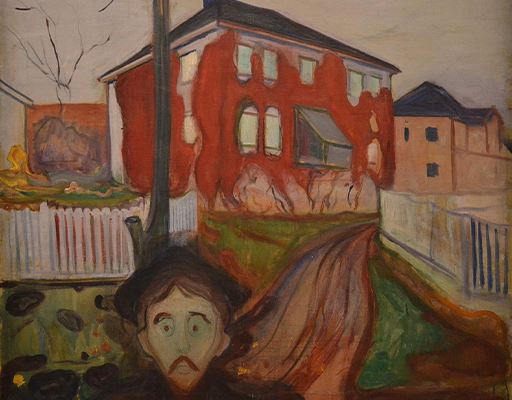
.Jpeg) Edvard Munch, Red Virginia Creeper, 1898-1900, oil on canvas, Munch Museum, Oslo
Edvard Munch, Red Virginia Creeper, 1898-1900, oil on canvas, Munch Museum, Oslo
A man in black stands wide-eyed, catatonic, as behind him the walls of a house run thick with blood. Red Virginia Creeper is a painting that is relatively simple in its execution. And it’s that simplicity that makes the piece’s impact so profound. Upon a mere glance, in conjunction with readings the painting’s title, the viewer can easily understand all that there is to know.
Munch created a series of paintings in the 1890s entitled the Frieze of Life – its themes consisted of love, anxiety, and death. Like the artist’s ubiquitous Scream, Red Virginia Creeper falls into the middle category. Munch himself suffered from acute anxiety, and the idea behind his Frieze of Life, was to creates pieces that were visual representations of certain feelings or moods that he had experienced. He was not interested in painting what he saw, but what he felt. It was not the eye that was important, but the mind’s eye. In Red Virigina Creeper, the glorious red leaves of the titular vine take on the appearance of blood, in accordance with what the visibly-distraught man in black has seen, has felt. It is a psychological portrayal of a swiftly-shattering psyche, and its effect is completely and utterly visceral.
.Jpeg)
Edvard Munch, The Night Wanderer, 1923-1924, oil on canvas, Munch Museum, Oslo
While it remains somewhat a mystery that Munch’s body of work is not more well-known in our current era, there are several factors that have historically contributed to the relative lack of recognition. The first being that most of the Norwegian artist’s paintings are housed in the nation’s capital city of Oslo, either at the Munch Museum, or the National Gallery. When Munch died, he donated a large number of his works to the municipality, and the original Munch Museum, opened in 1963 (commemorating what would have been the artist’s 100th birthday), had in its permanent possession well over half of the artist’s oeuvre. In fact, the dissemination of Munch’s physical work has been so dismal that Britain boasts only one of his paintings in a permanent collection (being the 1907 version of The Sick Child in the Tate). But, for the most part, Munch’s emotionally-honest subject matter, such as death, despair, and temporary insanity, are too prone to upset the oftentimes delicate sensibilities of the art-viewing public.
In comparison with the works of an artist such as Van Gogh, Munch’s pieces are a lot less benign. Despite the fact that Vincent suffered tremendously during many periods of his life, and often infused his paintings with a similar anxiety, Starry Night does not contain the same startling intensity as Red Virginia Creeper. It possesses an indisputable intensity, yes, but one that is much more subtle in its representation of the crippling anxiety and emotion that its creator felt. In short, Van Gogh is a lot more palatable.
Munch’s oeuvre is a veritable gold mine of poignancy and awaits any soul that is willing to use The Scream as a portal into works unknown.
For more on auctions, exhibitions, and current trends, visit our Magazine Page