An Ethereal Treatment of Light and Shadow: The Paintings of Jean-Jacques Henner
Jean-Jacques Henner, a 19th-century French painter, mastered chiaroscuro and sfumato, blending light and shadow to create ethereal, emotionally resonant works
Benjamin Blake Evemy / MutualArt
Nov 22, 2024
A lily-white nymph reclines by a riverside; a partially-stripped Mary Magdalene gazes repentant from where she sits slumped against the wall of her Teacher’s tomb; a Venus with hair like spreading flame is kissed by light and shadow. Through a marriage of the Renaissance techniques of sfumato and chiaroscuro, 19th-century French painter Jean-Jacques Henner created pieces in which his subjects seemingly radiate, like lantern light in a pitch-dark forest.
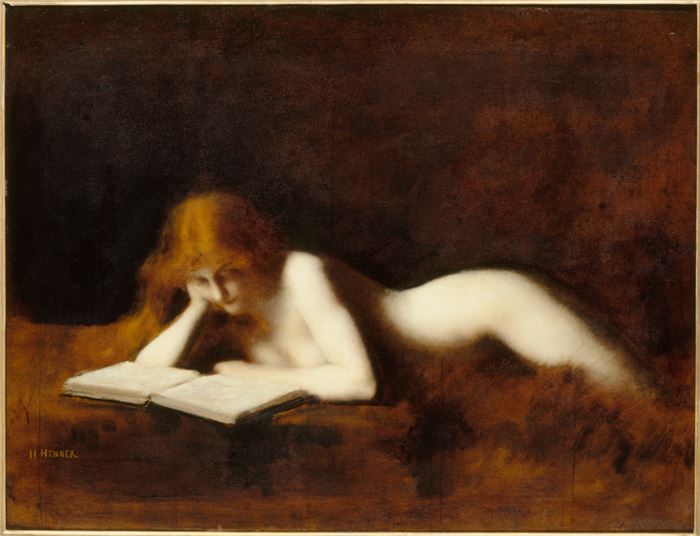 Jean-Jacques Henner, La Liseuse, 1880-1890, oil on canvas, Musée d’Orsay, Paris
Jean-Jacques Henner was born in March of 1829, in the Alsatian village of Bernwiller – the youngest of a modest, hardworking family. His artistic talent manifested at a young age, and proved to be the boy’s true strength, for he was a frail child, not naturally suited to the task of tilling the earth, which was the family trade. Thankfully, Henner’s parents recognized the fact, and encouraged their son’s obvious interest in drawing, exempting him to work in the fields like the other children. Jean-Jacques’ father, clearly an extremely supportive and understanding figure, would tell the young boy that he would become a great artist. He also told the other boys that they were to continue to support his artistic achievements after he was gone. They would make good on this mandate.
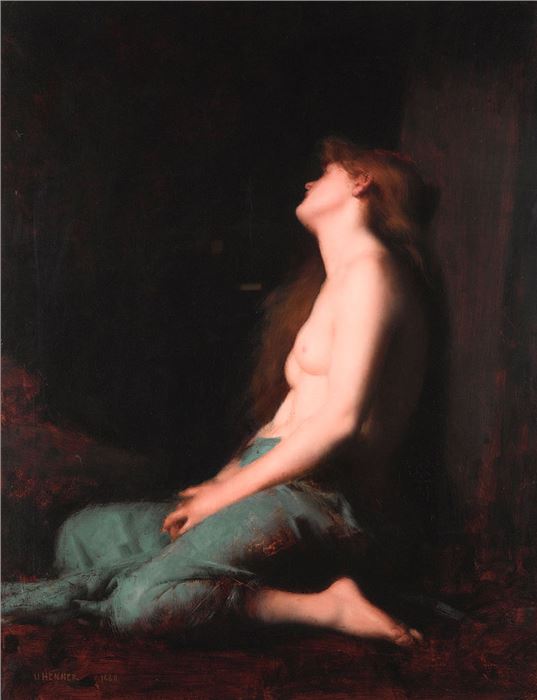
Jean-Jacques Henner, Solitude or Penitent Magdalene, c. 1881, oil on canvas, Cantor Arts Center at Stanford University, Stanford
Mary Magdalene is a subject often frequented by Henner. The artist possessed a penchant for painting both red-headed female nudes and religious themes, so the inclination naturally makes sense. In 1881’s Solitude, Magdalene leans against the tomb of Jesus, head tilted to her right, eyes shut tight, hands clasped, lost in throes of immense lamentation for her lost love. Due to Henner’s adept use of chiaroscuro, the subject’s pale flesh is in profound contrast to the stygian gloom of the tomb. The lustrous quality of her skin is also heightened by the coarseness of her robes.
Not only did Henner’s overall artistic talent manifest from a young age, his particular style also did. Upon completion of his schooling at Altkirch, his drawing-master, Charles Goutzwiller, advised him to go to Strasburg, where he entered the studio of Gabriel Guérin. It was here that his innate talent for chiaroscuro swiftly became apparent. When his master died, there was little keeping Henner in the region, and he promptly left for the nation’s capital.
Once in Paris, Henner entered the studio of neoclassicist Michel Drolling, but found himself struggling financially. He would take commissions for portraits where and when he could, but they were infrequent and oftentimes underpaid. Instead of asking his master for help, Henner decided to return to Alsace. He would remain in his home region for the next two years, working furiously and saving every franc he possibly could in order to return to Paris and resume his studies under Drolling.
Upon Henner’s return, Drolling did little to conceal his shock at his pupil’s long, unexplained absence. Yet being another figure in the young artist’s life who wholeheartedly believed in his talent and hard work, Drolling encouraged Henner to compete for the Prix de Rome. He also organized an annuity for the younger artist with the department of the Lower Rhine. Unfortunately, Henner’s master perished from a swift and merciless illness merely several days later, leaving the artist unable to truly thank him for all that he had done.
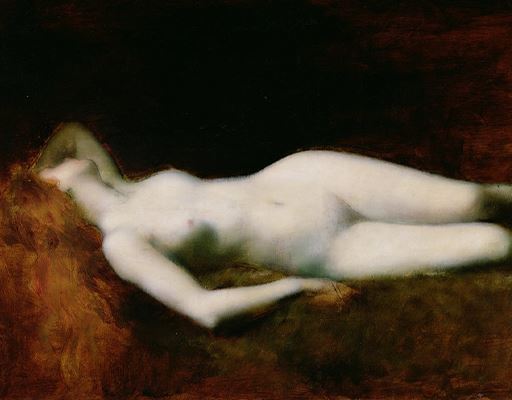
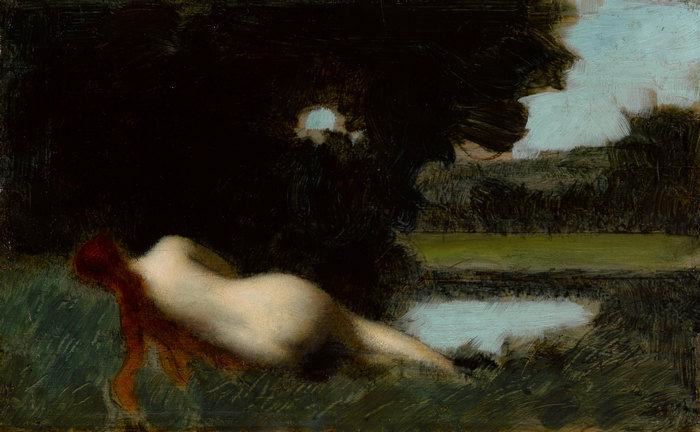 Jean-Jacques Henner, The Dream or Sleeping Nymph, c.1896-1900, oil on canvas, Musée national Jean-Jacques Henner, Paris
Henner’s The Dream, also known as Sleeping Nymph, showcases the artist’s skill with sfumato. The contours of the female nude take on an ethereal quality, the oil on canvas equivalent to the photographic soft focus. Henner was obviously very much aware of the subsequent effect, as both of the painting’s titles are oneiric, and one gazes upon the subject as if lost in the throes of dream themselves.
After being awarded a medal from the École des Beaux-Arts, which additionally granted him admission into the studio of François-Édouard Picot, Henner entered and won the Prix de Rome. Although, the joy of the accomplishment was somewhat bittersweet for the twenty-seven year old Henner, as his mother had died shortly beforehand. As a part of winning the award, Henner was granted the right to live in Rome for three to five years at the state’s expense. The artist thrived in the Italian capital, much enamored with the ancient city, completing one significant work for each of the five years he was in its sun-kissed streets.
Henner returned to Paris in 1865, where he moved into what would be his final home, situated in the Place Pigalle. Here, he entered a period of immense creativity. Perhaps the house itself had an effect conducive to painting, for it concurrently, and subsequently housed many great artists, including Théodore Rousseau, Giovanni Boldini, Puvis de Chavannes, and the brothers Dupré. Whether or not the dwelling itself served to attract and inspire painters, Henner certainly thrived there. He threw himself into his work with an ascetic fervor not dissimilar to that of a monk. His studio was his shrine, and it was there that he was completely and utterly in his element. In the mornings he would work on genre paintings and landscapes, and in the afternoons on portraits. His devotion to his work is evident in every piece, for he executed each to the highest of standards, refusing to merely produce for the sake of it.
But this relentless dedication was not without its side-effects. Being decidedly critical of every single piece produced, meant that Henner was oftentimes not completely satisfied with the outcome, and as a subsequence, the work was destroyed by the hand that created it. As mad as it may sound, this act of Godlike creation and destruction is a testament to Henner’s wholeheartedly earnest approach to his art, for there was no outside influence involved. His piece Study of a Young Girl earnt Henner a medal of the first class, yet he destroyed it upon its return to the studio. The following year The Toilet met the same fate, despite receiving high praise from the Salon.
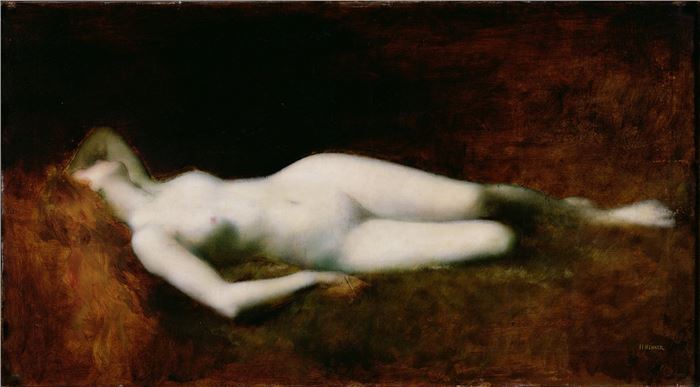 Jean-Jacques Henner, The Sleeper, date unknown, oil on canvas, Musée de Picardie, Amiens
Henner’s The Sleeper serves as the epitome of the artist’s ability to marry sfumato and chiaroscuro to result in a decidedly unique and immensely striking effect. The palest of women reposes on what, judging by the color and texture, appears to be a moss-soft patch of grass. The mass of her coppery auburn hair spills suffused into the bracken-esque brown of her surroundings, and the creeping darkness found in the upper lefthand corner forms a stark contrast against the ghostlike curves of her form. The Sleeper is a sumptuous piece, where desire springs forth both strong and soft, at first caressing and then all-consuming.
Jean-Jacques Henner was steadfast in his life’s work. He did not seek fame, nor riches – even though both did come, only to create what was true to his artistic vision. He died on July 23, 1905, aged 76, and was fittingly laid to rest in Paris’ Cimetière de Montmartre.
For more on auctions, exhibitions, and current trends, visit our Magazine Page