


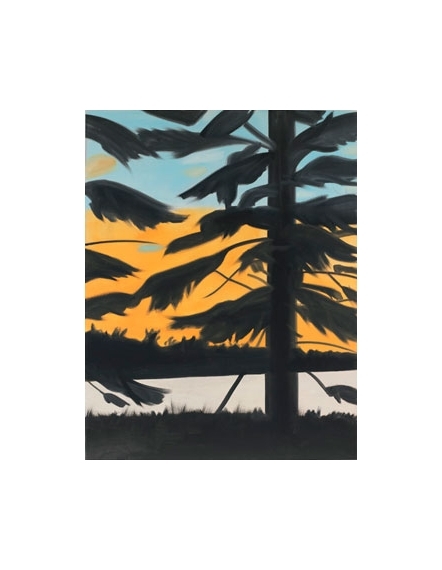
Alex Katz</a>. Alex Katz: Fifteen Minutes features approximately ten landscape paintings captured at twilight and sunset. Katz’s painting was central to the development of a new realism in the early 60s and today he remains one of the leading artists of his generation. Although primarily known for his large-scale flat portraiture, the artist has been painting from nature since the early 1950s. Alex Katz: Fifteen Minutes will be on view at 545 West 22nd Street from April 24 through June 13, 2009. The artist will be present at an opening reception on Thursday, April 23rd from 6-8 p.m.
Alex Katz once described his subjects as “quick things passing”—an idea that he embraced early in his career while studying plein air painting at the Skowhegan School for Painting and Sculpture in Maine the summer following his graduation from The Cooper Union in 1949. The northern New England environment captivated Katz and he has returned every summer to the Maine coast. In 1954 he began living and working in a 19th-century yellow clapboard farmhouse. The house and its surroundings have been the subject of numerous paintings over the years. In his new paintings at PaceWildenstein, Katz captures the soft, diffused Maine light when the sun is below the horizon—that terminal period of uncertainty as day fades into night. It was the Maine light,“which is richer and darker than the light in Impressionist paintings,” Katz once explained, that “helped me separate myself from European painting and find my own eyes.”
Katz has painted the Maine light falling beyond tree branches throughout the 1990s and into the new millennium, capturing the ever-changing light in the cycles of the day and seasons in a succession of instant moments.“For some of the twilight paintings,” Katz recalls, “I remember sitting all day waiting for that interval around 8:45 pm. I’d put down the coffee and paint for just those fifteen minutes. Later I’d try to figure out what I’d done, and on that basis do another, and a third, and a fourth.”
The technique of painting directly from life that Katz learned at Skowhegan has remained central to his practice today. From his summers in Maine, his studio in New York, and the friends, family and culture that surround him, Katz paints what he sees. His first night painting, Wet Evening (1986), portrayed the ever-glowing city lights of Manhattan’s skyline. Other urban night scenes, including such seminal works as Varick(1988) and his more recent variations from 2008, Varick 1 and Varick 2, have reappeared throughout his career. “From photography I can’t get any colours and I can’t get the light I’m interested in,” the artist once remarked; “I want to go into areas where no one’s been in terms of time: at twilight, you get ten or fifteen minutes.”
Katz’s exhibition at PaceWildenstein coincides with Alex Katz: Reflections at the Museo delle Arti di Catanzaro, Calabria, Italy (on view through September 27, 2009) and with Alex Katz: An American Way of Seeing at the Sara Hildén Art Museum in Tampere, Finland, on view through May 30, 2009, which will travel to the Musée de Grenoble, France and the Museum Kurhaus Kleve, Germany through 2010. In addition, Alex Katz: Seeing, Drawing, Making, previously on view at The Gallery at Windsor in Vero Beach, Florida, will open at the Parrish Art Museum, Southampton, New York, in February 2010.
Later this month, Katz will be honored with The Medal Award from the Museum of Fine Arts, Boston and will also be among the first 150 members inducted into The Cooper Union Alumni Hall of Fame.
Alex Katz (b. Brooklyn, New York, 1927) studied painting under Morris Kantor at The Cooper Union Art School in Manhattan. Upon graduating in 1949, he was awarded a scholarship for summer study at the Skowhegan School for Painting and Sculpture in Maine. Katz had his first one-person exhibition at the Roko Gallery, New York in 1954. In the late 1950s he moved towards greater realism as he became increasingly interested in portraiture. Katz’s outsized canvases embraced the ambitious scale and energy associated with Abstract Expressionism while anticipating the contemporary subjects and vernacular of Pop art, radically separating him from the gestural figure painters and New Perceptual Realism. Since the early 1960s, film, television, and billboard advertising have remained central to the flat language of his work. In 1959, Katz began making cut-out paintings—freestanding or relief portraits that existed in actual space. His body of work also includes printmaking and set and costume design. Katz’s subjects have ranged from landscapes to individual and complex group portraits of dancers, fashion models in designer clothing, and the social world of painters, poets, critics, and colleagues surrounding him. Throughout his career, Katz has portrayed his friends and family, including his life-long muse, Ada, who was recently the subject of a major exhibition, Alex Katz Paints Ada,at The Jewish Museum, New York (2006-2007).
Katz's work has been included in hundreds of group and solo exhibitions internationally since 1951. Museum exhibitions featuring his night paintings include Alex Katz in Maine at The Farnsworth Art Museum and Wyeth Center, Maine (2005), which travelled to the Pennsylvania Academy of Fine Arts in 2006; Alex Katz: Nocturnal Paintings, The Cleveland Museum of Art, Ohio (1988); and Alex Katz: Under the Stars: Landscapes 1951–1995, Baltimore Museum of Art, Maryland (1996). Several major exhibitions of Katz's landscape and portrait painting in America and Europe followed his 1986 Whitney Museum of American Art retrospective and his 1988 print retrospective at the Brooklyn Museum of Art. The Paul J. Schupf Wing for the Works of Alex Katz at the Colby College Museum of Art, Maine, presents ongoing exhibitions of Katz’s paintings, cut-outs, drawings, and prints. It is one of the few wings of a museum in the United States devoted solely to the work of a single living artist.
Katz has received numerous accolades throughout his career, including, amongst others, Honorary Doctorate degrees from Colgate University, New York (2005) and Colby College, Maine (1984) and Lifetime Achievement Awards from the National Academy Museum, New York (2007) and the Queens Museum of Art Award (1987). He was inducted by the American Academy and Institute of Arts and Letters In 1988.
<a class="SingleLineItemLink" target="_blank" href=https://www.mutualart.com/Exhibition/Alex-Katz--Fifteen-Minutes/"/Artist/Alex-Katz/0B91DE33D54DE385">Works by Alex Katz</a> can be found in nearly 100 public collections worldwide, including The Art Institute of Chicago; Hirshhorn Museum and Sculpture Garden at the Smithsonian Institution, Washington, D.C.; The Metropolitan Museum of Art, New York; Musée National d’Art Moderne Centre Georges Pompidou, Paris; Museo Nacional Centro de Arte Reina Sofia, Madrid; Museum of Fine Arts, Boston; The Museum of Modern Art, New York; National Gallery of Art, Washington, D.C.; National Museum of American Art, Smithsonian Institute, Washington, D.C.; Philadelphia Museum of Art; The Tate Gallery, London; and the Whitney Museum of American Art, New York.
Alex Katz joined PaceWildenstein in 2001.
Additional information for Alex Katz: Fifteen Minutes is available upon request by contacting Jennifer Benz Joy at jjoy@pacewildenstein.com or Lauren Staub at lstaub@pacewildenstien.com or call 212.421.8987." />


Alex Katz: Fifteen Minutes
Apr 24, 2009 - Jun 13, 2009
NEW YORK, April 3, 2009— PaceWildenstein is pleased to present a new series of large-scale paintings on linen and canvas from 2004-2008 by Alex Katz. Alex Katz: Fifteen Minutes features approximately ten landscape paintings captured at twilight and sunset. Katz’s painting was central to the development of a new realism in the early 60s and today he remains one of the leading artists of his generation. Although primarily known for his large-scale flat portraiture, the artist has been painting from nature since the early 1950s. Alex Katz: Fifteen Minutes will be on view at 545 West 22nd Street from April 24 through June 13, 2009. The artist will be present at an opening reception on Thursday, April 23rd from 6-8 p.m.
Alex Katz once described his subjects as “quick things passing”—an idea that he embraced early in his career while studying plein air painting at the Skowhegan School for Painting and Sculpture in Maine the summer following his graduation from The Cooper Union in 1949. The northern New England environment captivated Katz and he has returned every summer to the Maine coast. In 1954 he began living and working in a 19th-century yellow clapboard farmhouse. The house and its surroundings have been the subject of numerous paintings over the years. In his new paintings at PaceWildenstein, Katz captures the soft, diffused Maine light when the sun is below the horizon—that terminal period of uncertainty as day fades into night. It was the Maine light,“which is richer and darker than the light in Impressionist paintings,” Katz once explained, that “helped me separate myself from European painting and find my own eyes.”
Katz has painted the Maine light falling beyond tree branches throughout the 1990s and into the new millennium, capturing the ever-changing light in the cycles of the day and seasons in a succession of instant moments.“For some of the twilight paintings,” Katz recalls, “I remember sitting all day waiting for that interval around 8:45 pm. I’d put down the coffee and paint for just those fifteen minutes. Later I’d try to figure out what I’d done, and on that basis do another, and a third, and a fourth.”
The technique of painting directly from life that Katz learned at Skowhegan has remained central to his practice today. From his summers in Maine, his studio in New York, and the friends, family and culture that surround him, Katz paints what he sees. His first night painting, Wet Evening (1986), portrayed the ever-glowing city lights of Manhattan’s skyline. Other urban night scenes, including such seminal works as Varick(1988) and his more recent variations from 2008, Varick 1 and Varick 2, have reappeared throughout his career. “From photography I can’t get any colours and I can’t get the light I’m interested in,” the artist once remarked; “I want to go into areas where no one’s been in terms of time: at twilight, you get ten or fifteen minutes.”
Katz’s exhibition at PaceWildenstein coincides with Alex Katz: Reflections at the Museo delle Arti di Catanzaro, Calabria, Italy (on view through September 27, 2009) and with Alex Katz: An American Way of Seeing at the Sara Hildén Art Museum in Tampere, Finland, on view through May 30, 2009, which will travel to the Musée de Grenoble, France and the Museum Kurhaus Kleve, Germany through 2010. In addition, Alex Katz: Seeing, Drawing, Making, previously on view at The Gallery at Windsor in Vero Beach, Florida, will open at the Parrish Art Museum, Southampton, New York, in February 2010.
Later this month, Katz will be honored with The Medal Award from the Museum of Fine Arts, Boston and will also be among the first 150 members inducted into The Cooper Union Alumni Hall of Fame.
Alex Katz (b. Brooklyn, New York, 1927) studied painting under Morris Kantor at The Cooper Union Art School in Manhattan. Upon graduating in 1949, he was awarded a scholarship for summer study at the Skowhegan School for Painting and Sculpture in Maine. Katz had his first one-person exhibition at the Roko Gallery, New York in 1954. In the late 1950s he moved towards greater realism as he became increasingly interested in portraiture. Katz’s outsized canvases embraced the ambitious scale and energy associated with Abstract Expressionism while anticipating the contemporary subjects and vernacular of Pop art, radically separating him from the gestural figure painters and New Perceptual Realism. Since the early 1960s, film, television, and billboard advertising have remained central to the flat language of his work. In 1959, Katz began making cut-out paintings—freestanding or relief portraits that existed in actual space. His body of work also includes printmaking and set and costume design. Katz’s subjects have ranged from landscapes to individual and complex group portraits of dancers, fashion models in designer clothing, and the social world of painters, poets, critics, and colleagues surrounding him. Throughout his career, Katz has portrayed his friends and family, including his life-long muse, Ada, who was recently the subject of a major exhibition, Alex Katz Paints Ada,at The Jewish Museum, New York (2006-2007).
Katz's work has been included in hundreds of group and solo exhibitions internationally since 1951. Museum exhibitions featuring his night paintings include Alex Katz in Maine at The Farnsworth Art Museum and Wyeth Center, Maine (2005), which travelled to the Pennsylvania Academy of Fine Arts in 2006; Alex Katz: Nocturnal Paintings, The Cleveland Museum of Art, Ohio (1988); and Alex Katz: Under the Stars: Landscapes 1951–1995, Baltimore Museum of Art, Maryland (1996). Several major exhibitions of Katz's landscape and portrait painting in America and Europe followed his 1986 Whitney Museum of American Art retrospective and his 1988 print retrospective at the Brooklyn Museum of Art. The Paul J. Schupf Wing for the Works of Alex Katz at the Colby College Museum of Art, Maine, presents ongoing exhibitions of Katz’s paintings, cut-outs, drawings, and prints. It is one of the few wings of a museum in the United States devoted solely to the work of a single living artist.
Katz has received numerous accolades throughout his career, including, amongst others, Honorary Doctorate degrees from Colgate University, New York (2005) and Colby College, Maine (1984) and Lifetime Achievement Awards from the National Academy Museum, New York (2007) and the Queens Museum of Art Award (1987). He was inducted by the American Academy and Institute of Arts and Letters In 1988.
Works by Alex Katz can be found in nearly 100 public collections worldwide, including The Art Institute of Chicago; Hirshhorn Museum and Sculpture Garden at the Smithsonian Institution, Washington, D.C.; The Metropolitan Museum of Art, New York; Musée National d’Art Moderne Centre Georges Pompidou, Paris; Museo Nacional Centro de Arte Reina Sofia, Madrid; Museum of Fine Arts, Boston; The Museum of Modern Art, New York; National Gallery of Art, Washington, D.C.; National Museum of American Art, Smithsonian Institute, Washington, D.C.; Philadelphia Museum of Art; The Tate Gallery, London; and the Whitney Museum of American Art, New York.
Alex Katz joined PaceWildenstein in 2001.
Additional information for Alex Katz: Fifteen Minutes is available upon request by contacting Jennifer Benz Joy at jjoy@pacewildenstein.com or Lauren Staub at lstaub@pacewildenstien.com or call 212.421.8987.
Recommended for you
Feb 15,2025
- May 18,2025
Feb 15,2025
- May 18,2025
Feb 15,2025
- Mar 29,2025
NEW YORK, April 3, 2009— PaceWildenstein is pleased to present a new series of large-scale paintings on linen and canvas from 2004-2008 by Alex Katz. Alex Katz: Fifteen Minutes features approximately ten landscape paintings captured at twilight and sunset. Katz’s painting was central to the development of a new realism in the early 60s and today he remains one of the leading artists of his generation. Although primarily known for his large-scale flat portraiture, the artist has been painting from nature since the early 1950s. Alex Katz: Fifteen Minutes will be on view at 545 West 22nd Street from April 24 through June 13, 2009. The artist will be present at an opening reception on Thursday, April 23rd from 6-8 p.m.
Alex Katz once described his subjects as “quick things passing”—an idea that he embraced early in his career while studying plein air painting at the Skowhegan School for Painting and Sculpture in Maine the summer following his graduation from The Cooper Union in 1949. The northern New England environment captivated Katz and he has returned every summer to the Maine coast. In 1954 he began living and working in a 19th-century yellow clapboard farmhouse. The house and its surroundings have been the subject of numerous paintings over the years. In his new paintings at PaceWildenstein, Katz captures the soft, diffused Maine light when the sun is below the horizon—that terminal period of uncertainty as day fades into night. It was the Maine light,“which is richer and darker than the light in Impressionist paintings,” Katz once explained, that “helped me separate myself from European painting and find my own eyes.”
Katz has painted the Maine light falling beyond tree branches throughout the 1990s and into the new millennium, capturing the ever-changing light in the cycles of the day and seasons in a succession of instant moments.“For some of the twilight paintings,” Katz recalls, “I remember sitting all day waiting for that interval around 8:45 pm. I’d put down the coffee and paint for just those fifteen minutes. Later I’d try to figure out what I’d done, and on that basis do another, and a third, and a fourth.”
The technique of painting directly from life that Katz learned at Skowhegan has remained central to his practice today. From his summers in Maine, his studio in New York, and the friends, family and culture that surround him, Katz paints what he sees. His first night painting, Wet Evening (1986), portrayed the ever-glowing city lights of Manhattan’s skyline. Other urban night scenes, including such seminal works as Varick(1988) and his more recent variations from 2008, Varick 1 and Varick 2, have reappeared throughout his career. “From photography I can’t get any colours and I can’t get the light I’m interested in,” the artist once remarked; “I want to go into areas where no one’s been in terms of time: at twilight, you get ten or fifteen minutes.”
Katz’s exhibition at PaceWildenstein coincides with Alex Katz: Reflections at the Museo delle Arti di Catanzaro, Calabria, Italy (on view through September 27, 2009) and with Alex Katz: An American Way of Seeing at the Sara Hildén Art Museum in Tampere, Finland, on view through May 30, 2009, which will travel to the Musée de Grenoble, France and the Museum Kurhaus Kleve, Germany through 2010. In addition, Alex Katz: Seeing, Drawing, Making, previously on view at The Gallery at Windsor in Vero Beach, Florida, will open at the Parrish Art Museum, Southampton, New York, in February 2010.
Later this month, Katz will be honored with The Medal Award from the Museum of Fine Arts, Boston and will also be among the first 150 members inducted into The Cooper Union Alumni Hall of Fame.
Alex Katz (b. Brooklyn, New York, 1927) studied painting under Morris Kantor at The Cooper Union Art School in Manhattan. Upon graduating in 1949, he was awarded a scholarship for summer study at the Skowhegan School for Painting and Sculpture in Maine. Katz had his first one-person exhibition at the Roko Gallery, New York in 1954. In the late 1950s he moved towards greater realism as he became increasingly interested in portraiture. Katz’s outsized canvases embraced the ambitious scale and energy associated with Abstract Expressionism while anticipating the contemporary subjects and vernacular of Pop art, radically separating him from the gestural figure painters and New Perceptual Realism. Since the early 1960s, film, television, and billboard advertising have remained central to the flat language of his work. In 1959, Katz began making cut-out paintings—freestanding or relief portraits that existed in actual space. His body of work also includes printmaking and set and costume design. Katz’s subjects have ranged from landscapes to individual and complex group portraits of dancers, fashion models in designer clothing, and the social world of painters, poets, critics, and colleagues surrounding him. Throughout his career, Katz has portrayed his friends and family, including his life-long muse, Ada, who was recently the subject of a major exhibition, Alex Katz Paints Ada,at The Jewish Museum, New York (2006-2007).
Katz's work has been included in hundreds of group and solo exhibitions internationally since 1951. Museum exhibitions featuring his night paintings include Alex Katz in Maine at The Farnsworth Art Museum and Wyeth Center, Maine (2005), which travelled to the Pennsylvania Academy of Fine Arts in 2006; Alex Katz: Nocturnal Paintings, The Cleveland Museum of Art, Ohio (1988); and Alex Katz: Under the Stars: Landscapes 1951–1995, Baltimore Museum of Art, Maryland (1996). Several major exhibitions of Katz's landscape and portrait painting in America and Europe followed his 1986 Whitney Museum of American Art retrospective and his 1988 print retrospective at the Brooklyn Museum of Art. The Paul J. Schupf Wing for the Works of Alex Katz at the Colby College Museum of Art, Maine, presents ongoing exhibitions of Katz’s paintings, cut-outs, drawings, and prints. It is one of the few wings of a museum in the United States devoted solely to the work of a single living artist.
Katz has received numerous accolades throughout his career, including, amongst others, Honorary Doctorate degrees from Colgate University, New York (2005) and Colby College, Maine (1984) and Lifetime Achievement Awards from the National Academy Museum, New York (2007) and the Queens Museum of Art Award (1987). He was inducted by the American Academy and Institute of Arts and Letters In 1988.
Works by Alex Katz can be found in nearly 100 public collections worldwide, including The Art Institute of Chicago; Hirshhorn Museum and Sculpture Garden at the Smithsonian Institution, Washington, D.C.; The Metropolitan Museum of Art, New York; Musée National d’Art Moderne Centre Georges Pompidou, Paris; Museo Nacional Centro de Arte Reina Sofia, Madrid; Museum of Fine Arts, Boston; The Museum of Modern Art, New York; National Gallery of Art, Washington, D.C.; National Museum of American Art, Smithsonian Institute, Washington, D.C.; Philadelphia Museum of Art; The Tate Gallery, London; and the Whitney Museum of American Art, New York.
Alex Katz joined PaceWildenstein in 2001.
Additional information for Alex Katz: Fifteen Minutes is available upon request by contacting Jennifer Benz Joy at jjoy@pacewildenstein.com or Lauren Staub at lstaub@pacewildenstien.com or call 212.421.8987.
Artists on show
Contact details
Tuesday - Saturday
10:00 AM - 6:00 PM
508 West 25th Street Chelsea - New York, NY, USA 10001

What's on nearby
exhibition of Nevelson</a>’s late works, curated by gallery founder Arne Glimcher, at its 540 West 25th Street location in New York.</p><p>On view from January 17 to March 1, 2025, this show will place Nevelson’s iconic monochromatic sculptures in black and white in dialogue with her collages—including several rarely seen and never previously exhibited masterworks—made in the 1970s and 1980s.</p><p>Like Mondrian’s, Nevelson’s compositions are based on a strict adherence to vertical and horizontal regularity. During the 1970s and 1980s, there was a significant development: Nevelson incorporated the diagonal into her vocabulary. A new, angular energy surfaced in many of the works she produced during this period, breaking the rules by which she traditionally composed her work.</p><p>These late works shed new light on her evolving aesthetic, bringing into focus a series of remarkably productive years of her practice in which she experimented with a new vocabulary of robust, muscular, and often minimal forms while staying true to her lifelong investigations of materiality, shape, and shadow.</p><p>Rooted in the legacies of Cubism and Constructivism, Nevelson’s artworks were widely celebrated during her lifetime for incorporating unexpected combinations of materials and forms. As part of her distinctive approach to abstraction, the artist often explored the myriad possibilities of collage—a technique she transposed into sculpture by means of compartmentalized elements and forms liberated from everyday meaning. Nevelson’s use of the collage aesthetic was formalist. Her art of scavenging and her affinity for the materiality of wood are linked to her personal life and her remarkable story.</p><p><br></p>" />

Jan 17,2025
- Mar 01,2025
Misrach at its 540 West 25th Street gallery in New York. On view from January 17 to March 1, 2025, this will be the first presentation devoted to CARGO, a body of work that Misrach began in 2021 during the COVID-19 pandemic.</p><p>During the last week of the show, advance copies of CARGO (Aperture, May 2025) will be available to view at the gallery. Pace will also host a talk between the artist and Sarah Meister, Executive Director of Aperture.</p><p>Misrach is known for his poignant, large-scale color images that lean into social, political, and environmental issues while also engaging with the history of photography. In his radiant, contemplative works, Misrach—who is based in California—often examines the destructive impact of human interaction with the natural world. His works have examined man-made fires and floods, nuclear test sites, and animal burial pits in the American West; the petrochemical corridor in Louisiana; the landscape of the US-Mexico border; as well as more lyrical subjects like San Francisco’s iconic Golden Gate Bridge and his recent hydrofoil surfer series in Hawaii.</p><p><br></p>" />

Jan 17,2025
- Mar 01,2025
Keyser’s career</a> from the 1980s to the 2000s. The exhibition, which marks the first time the gallery has shown such an expansive selection of De Keyser’s oeuvre, follows David Zwirner’s celebrated presentations of the artist’s work in Hong Kong in 2021 and 2022, and, in 2016, Raoul De Keyser: Drift, his last solo exhibition in New York, which was first on view at David Zwirner London in 2015–2016.</p><p>Throughout the course of his highly influential career, De Keyser engaged in a singular investigation of the potential expression and pictorial capabilities of abstract painting. Made up of simple shapes and painterly marks, his works allude to the natural world and representational imagery while avoiding suggestions of narrative or reductive frameworks that limit experience and interpretation. De Keyser’s ability to find new and exciting ways to invigorate his surfaces resulted in his reception as a major influence for contemporary painters—“an artist’s artist.” Though De Keyser has been the subject of numerous surveys and solo exhibitions at museums and institutions in Europe since the 1970s, this exhibition will be a rare opportunity for New York audiences to experience the breadth of his practice, his beguiling sense of color, his deft and delicate surfaces, and his sometimes poetic, sometimes mysterious, sometime rigorously formal paintings.</p><p><br></p>" />

Jan 16,2025
- Mar 01,2025
