


The Modern and Contemporary Ink Art of the Republic of Korea and the People's Republic of China
Nov 28, 2024 - Feb 16, 2025
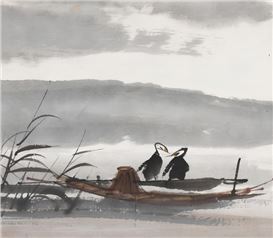
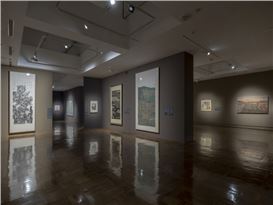
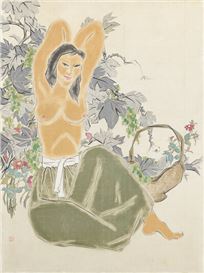
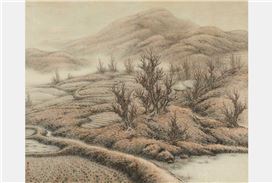
This exhibition offers a comprehensive view of representative works of modern and contemporary ink and color paintings from the collections of the National Museum of Modern and Contemporary Art, Korea (MMCA), and the National Museum of China (NAMOC), China’s sole state-run art institution. The first ever to be co-curated by Korea and China, this exhibition narrates the history of East Asian painting from an independent view, departing from the European and American perspectives that have long dominated the discourse. Examining how ink and color paintings—the very foundation of East Asian art—have inherited and contemporized tradition since modern times, this exhibition highlights various aspects of the development and characteristics of East Asian ink and color paintings ranging from traditional portraits, landscapes, and flower-and-bird paintings to contemporary figurative and non-figurative paintings. Demonstrating how this genre employing common media manifests in distinct aesthetics and identities shaped by the unique cultures and sensibilities of Korea and China, this exhibition provides an opportunity to experience the beauty in each East Asian country’s approach to ink and color. Accompanied by an associated workshop and an international academic conference, this cultural and artistic exchange between Korea and China is expected to strengthen the ties between the two countries, especially in light of current political tensions.

Recommended for you

Feb 15,2025
- May 15,2025


Feb 08,2025
- Apr 05,2025

Feb 08,2025
- Apr 05,2025
This exhibition offers a comprehensive view of representative works of modern and contemporary ink and color paintings from the collections of the National Museum of Modern and Contemporary Art, Korea (MMCA), and the National Museum of China (NAMOC), China’s sole state-run art institution. The first ever to be co-curated by Korea and China, this exhibition narrates the history of East Asian painting from an independent view, departing from the European and American perspectives that have long dominated the discourse. Examining how ink and color paintings—the very foundation of East Asian art—have inherited and contemporized tradition since modern times, this exhibition highlights various aspects of the development and characteristics of East Asian ink and color paintings ranging from traditional portraits, landscapes, and flower-and-bird paintings to contemporary figurative and non-figurative paintings. Demonstrating how this genre employing common media manifests in distinct aesthetics and identities shaped by the unique cultures and sensibilities of Korea and China, this exhibition provides an opportunity to experience the beauty in each East Asian country’s approach to ink and color. Accompanied by an associated workshop and an international academic conference, this cultural and artistic exchange between Korea and China is expected to strengthen the ties between the two countries, especially in light of current political tensions.
Artists on show
- Lin Songnian
- Liu Yunquan
- Ahn Dongsook
- An Jungsik
- An Sangchul
- Ayoung Kim
- Chang Unsang
- Chang WooSung
- Chen Dayu
- Chen Jialing
- Chen Jian
- Chen Liu
- Chen Long
- Chen Shuren
- Chen Zhifo
- Chen Zifen
- Cho Hwan
- Cho Inho
- Cho PoongRyu
- Choi Seokhwan
- Choi Wooseok
- Chun Kyung-Ja
- Cui Jian
- Cui Jin
- Cui Zhenkuan
- Du Dakai
- Fang Jun
- Feng Changjiang
- Fu Baoshi
- Gao Jianfu
- Guan Liang
- Guo Yicong
- Han Guozhen
- Han Jingwei
- Han Shuo
- Heo Baekryeon
- Heo Geon
- Heo Haeng Myeon
- Hong Soonjoo
- Hong SukChang
- Hu Huidong
- Hu Mingzhe
- Hu Peiheng
- Huang Anren
- Huang Qiuyuan
- Huang Zhou
- Hur Jin
- Hwang Changbae
- Jaeho Jung
- Jiang Baolin
- Jin Meisheng
- Jung Jongmee
- Kang KyungKu
- Kim Bohie
- KIM Chun-ok
- Kim EunHo
- Kim Hodeuk
- Kim Jung Sun
- Kim Ki Chang
- Kim Kyounghwan
- Kim Sun Doo
- Kim Yongjin
- Kwon Youngwoo
- Lee cheoljoo
- Lee Doyoung
- Lee Eunsil
- Lee Geuntaek
- Lee Jinju
- Lee Jongmin
- Lee Jongmok
- Lee JongSang
- Lee Sang-Beom
- Lee Sook Ja
- Lee Ungno
- Lee Whaja
- Lee Yongwoo
- Lee Yootae
- Lee Youngchan
- Li Bo An
- Li Chuanzhen
- Li Keran
- Li Kuchan
- Li Xuesong
- Li Yuzi
- Liao Bingxiong
- Lin Fengmian
- Lin Rongsheng
- Liu Gang
- Liu Haisu
- Lu Qinglong
- Lu Xiujing
- Luo Ping'an
- Min Kyung Kap
- Mo Xiaosong
- Niu Kecheng
- Noh Soohyun
- Oh Sangtaek
- Oh Yongkil
- Pan Jiezi
- Park Daesung
- Park Nosoo
- Park RaeHyun
- Park SaengKwang
- Park Seungmoo
- Pyon Kwansik
- Qi Baishi
- Qi Kun
- Qian Songyan
- Rhee Chulryang
- Seung Hwan Oh
- Shim Kyungia
- Son Donghyun
- Song Soonam
- Song SooRyun
- Su Baijun
- Suh JungTae
- Suh Se Ok
- Suk Chul-Joo
- Te Wei
- Tian Liming
- Tong Zhongtao
- Won Moonja
- Wu Changshi
- Wu Weishan
- Wu Yueshi
- Wu Zuoren
- Xiong Honggang
- Xu Beihong
- Yang Zhiguang
- Ye Qianyu
- Yu Fei'an
- Zeng Sankai
- Zhang Daqian
- Zhang Ding
- Zhang Guiming
- Zhang Jian
- Zhang Lichen
- Zhang Shiying
- Zhao Long
- Zhao Zhiqian
- Zhou Ruolan
- Zhu Daoping
- Zhu Zhengeng
- Zong Qixiang

Related articles
December 2, 2024
The National Museum of Modern and Contemporary Art, in collaboration with the China Art Museum, is presenting the exhibition...
December 11, 2024
The National Museum of Modern and Contemporary Art, Korea has brought together masterpieces of modern and contemporary ink art from South Korea and China at its Deoksugung venue in Seoul.
December 13, 2024
The Modern and Contemporary Ink Art of the Republic of Korea and the People’s Republic of China.
The Modern and Contemporary Art, Korea and the National Art Museum of China Present Joint Exhibition
December 14, 2024
Serving as a platform to enhance artistic exchange and mutual understanding between the two countries, the exhibition also opens a new chapter in the study of East Asian ink and color painting through various related workshops and international academic conferences.
What's on nearby

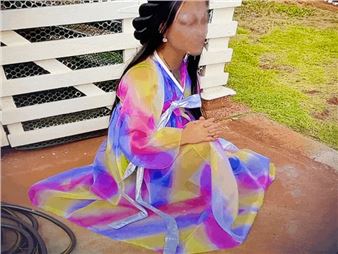
solo exhibition by Sung Hwan Kim</a> is organized under the auspices of an annual exhibition series highlighting contemporary Korean artists. This exhibition centers on A Record of Drifting Across the Sea, a multi-part research work the artist has been delving into since 2017 and invites viewers to become witnesses and producers of the very sites where such “events of knowledge” take place.</p><p>A Record of Drifting Across the Sea is a project beginning with the stories of early 20th century Korean immigrants to the United States who passed through “Hawai‘i”. It expands these narratives to include issues of boundaries, tradition, documentation, possession, and circulation, among others, while addressing the relationship between systems and knowledge. Kim zeroes in on the fact that despite being situated within the larger historical narrative of modernity and colonization, the lives of many of these early immigrants have never been properly addressed in the prevailing historical narratives of Korea or the U.S. In following these lives that exist outside more widely established narratives, the artist is taking a multivalent approach to addressing the issues that surround acts of knowledge by taking stories from either side of various boundaries and weaving them together. By the same token, he also explores how systems of knowledge work to shape an individual’s thinking and gaze. Here, “Hawai‘i” is both a concept and as a specific geographic location. Beginning in the mid-19th century, with the flourishing of large-scale industrial plantations, countless overseas laborers were introduced to Hawai‘i; Chinese immigrants were followed by an influx from Japan, and then Korea, each wave shaped by the flow of capital and shifting immigration laws. The first officially documented Korean migrants were the 120 or so individuals who left Incheon Harbor in 1902, holding passports issued by the Korean Empire and arriving in Hawai‘i in 1903. This marked a turning point after which many Koreans came to settle in the mainland US via Hawai‘i. At the time, Hawai‘i was home to many who found themselves adrift, whether migrant workers hailing from Korea and elsewhere, refugees fleeing war, or native Hawaiians who had lost their ‘āina (land) when it was forcibly annexed by the United States in 1898. Even as Hawai‘i is a concrete place where lives and cultures drift across ethnic and regional boundaries, it is also a conceptual location in which we can examine the dynamics of the various forces in play all the way through to the present day. As a metaphor, Hawai‘i serves as the chosen site for the questioning of existing knowledge systems, intersecting them with different systems of knowing, and constructing entirely new structures of knowing. This exhibition unpacks the ways in which the knowledge we call history is formed and disseminated, right alongside the traces that have long been relegated to the margins of such recorded history, proposing Hawai‘i as a lens through which we might consider the whole without sacrificing complexity.</p><p><br></p>" />
Dec 19,2024
- Mar 30,2025

Feb 26,2025
- Apr 12,2025
