Susan Hiller</a>’s Die gedanken sind frei (Thoughts are free) 2012 is a large-scale installation featuring a customised Wurlitzer jukebox which plays more than 100 revolutionary anthems, spanning 16th-century German peasant ballads to anti-fascist folksongs and contemporary rap. Relocated from its more common setting of the mid-20th-century diner to a shrine-like space, Hiller’s jukebox invites visitors to choose a song and set the soundtrack for the exhibition, which also includes works such as <a target="_blank" href=https://www.mutualart.com/Exhibition/What-Does-The-Jukebox-Dream-Of-/"/Artist/Paul-Chan/93105CA87667F698">Paul Chan</a>’s Oh why so serious? 2008, <a target="_blank" href=https://www.mutualart.com/Exhibition/What-Does-The-Jukebox-Dream-Of-/"/Artist/David-Haines---Joyce-Hinterding/66A3C260288B0298">David Haines and Joyce Hinterding</a>’s The outlands 2011, <a target="_blank" href=https://www.mutualart.com/Exhibition/What-Does-The-Jukebox-Dream-Of-/"/Artist/Fiona-Hall/6D362C869F0A7B95">Fiona Hall</a>’s Slash and burn 1997, <a target="_blank" href=https://www.mutualart.com/Exhibition/What-Does-The-Jukebox-Dream-Of-/"/Artist/Callum-Morton/2D3D26209228162F">Callum Morton</a>’s Screen #7 Here and There 2006 and <a target="_blank" href=https://www.mutualart.com/Exhibition/What-Does-The-Jukebox-Dream-Of-/"/Artist/Ricky-Swallow/1C6D9F9C7D06BA25">Ricky Swallow</a>’s Idol with handle 1997–2007 as well as a series of <a target="_blank" href=https://www.mutualart.com/Exhibition/What-Does-The-Jukebox-Dream-Of-/"/Artist/Max-Dupain/EC9A35EC9E3E056F">photographs by Max Dupain</a>.</p><p>Disrupting a naturalised, linear story of technological development – where the Walkman is eclipsed by the iPod and so on – the exhibition celebrates the playful ways in which artists envision emancipatory new uses for ‘obsolete’ technologies.</p><p><br></p>" />

What Does The Jukebox Dream Of?

Mar 09, 2024 - Nov 17, 2024

Videogame joysticks, a fossilised radio, VHS tapes spun into haunting life-size figures ... this exhibition reanimates supposedly defunct media.

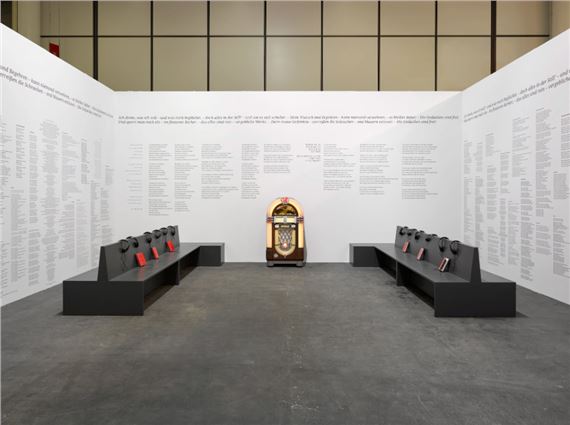
On display for the first time in Australia, Susan Hiller’s Die gedanken sind frei (Thoughts are free) 2012 is a large-scale installation featuring a customised Wurlitzer jukebox which plays more than 100 revolutionary anthems, spanning 16th-century German peasant ballads to anti-fascist folksongs and contemporary rap. Relocated from its more common setting of the mid-20th-century diner to a shrine-like space, Hiller’s jukebox invites visitors to choose a song and set the soundtrack for the exhibition, which also includes works such as Paul Chan’s Oh why so serious? 2008, David Haines and Joyce Hinterding’s The outlands 2011, Fiona Hall’s Slash and burn 1997, Callum Morton’s Screen #7 Here and There 2006 and Ricky Swallow’s Idol with handle 1997–2007 as well as a series of photographs by Max Dupain.

Disrupting a naturalised, linear story of technological development – where the Walkman is eclipsed by the iPod and so on – the exhibition celebrates the playful ways in which artists envision emancipatory new uses for ‘obsolete’ technologies.


Videogame joysticks, a fossilised radio, VHS tapes spun into haunting life-size figures ... this exhibition reanimates supposedly defunct media.

On display for the first time in Australia, Susan Hiller’s Die gedanken sind frei (Thoughts are free) 2012 is a large-scale installation featuring a customised Wurlitzer jukebox which plays more than 100 revolutionary anthems, spanning 16th-century German peasant ballads to anti-fascist folksongs and contemporary rap. Relocated from its more common setting of the mid-20th-century diner to a shrine-like space, Hiller’s jukebox invites visitors to choose a song and set the soundtrack for the exhibition, which also includes works such as Paul Chan’s Oh why so serious? 2008, David Haines and Joyce Hinterding’s The outlands 2011, Fiona Hall’s Slash and burn 1997, Callum Morton’s Screen #7 Here and There 2006 and Ricky Swallow’s Idol with handle 1997–2007 as well as a series of photographs by Max Dupain.

Disrupting a naturalised, linear story of technological development – where the Walkman is eclipsed by the iPod and so on – the exhibition celebrates the playful ways in which artists envision emancipatory new uses for ‘obsolete’ technologies.


Contact details

Sunday
10:00 AM - 5:00 PM
Wednesday
10:00 AM - 9:00 PM
Thursday - Saturday
10:00 AM - 5:00 PM
Art Gallery Road Sydney, Australia 2000

What's on nearby

Artereal Gallery is honoured to present Ripple, an ambitious solo exhibition by Kate <a target="_blank" href=https://www.mutualart.com/Exhibition/What-Does-The-Jukebox-Dream-Of-/"/Artist/Kate-Vassallo/1F621BB84D93F516">Vassallo, showcasing a selection of her recent works spanning painting and drawing. This exhibition holds special significance as it marks our final show before Artereal Gallery closes its doors permanently after 19 years of championing contemporary art. Ripple reflects Vassallo’s ongoing exploration of time and labour, and serves as a fitting conclusion to our gallery’s rich legacy of presenting thought-provoking, innovative art. The exhibition follows on from her recent milestones including the 2024 Dobell Australian Drawing Biennale at the Art Gallery of New South Wales and a major commission with Creative Road Art Projects as part of the Canberra Hospital Expansion Project. As we close this chapter, we take immense pride in the impact Artereal has had on both artists and the Australian art community, leaving behind a lasting influence on the way art is experienced, collected and appreciated.</p><p><br></p>" />
Map View
Sign in to MutualArt.com