Prices & Predictions Post-Miami Art Week
Art Basel revealed a resurgence in art fairs, shifting collector preferences, rising textile art demand, and expanding interest in diverse mediums and underrepresented artists
Maya Garabedian / MutualArt
Dec 24, 2024
Trends in blue-chip art sales can be hard to identify. The biggest contributors to global market value are typically a small percentage of buyers, meaning the factors behind buying and selling can be quite individual. Amid a global pandemic, contrary to expectations, art sales flourished despite volatile economic instability. During that era, digital showrooms and online fairs became the norm. Credible voices in the industry predicted that old-school brick-and-mortar models, like physical fairs and auctions, would become obsolete, and that COVID fast-tracked an inevitable technological shift. And while the number of art fairs did decline during the pandemic, they’ve been rising ever since – an estimated 408 fairs in 2019, 333 in 2023, and over 377 in 2024. Even the resurgence of art fairs is counterintuitive. I find myself leaving booths worried about their bottom line. At Art Basel in Miami, the cost of a gallery booth (including travel, accommodation, shipping, setup, dinners, and promotional events) is astronomical. Even with the sliding scale introduced in 2019, which reduced costs for smaller galleries, the price of participation tends to clock in at six figures. All things considered, I suppose a small gallery exhibiting a solo show for an East Coast artist with no extra frills like dinner parties could keep their costs down to $50,000, but most exhibitors don’t hit a low-operating-cost jackpot like that and fork out $100,000 to $400,000. Knowing that high exhibition costs like these are a leading cause of gallery closure, it’s hard not to walk through preview days with bated breath. Those first days set the tone for a fair’s sales, and those sales are some of the best indicators of future trends.
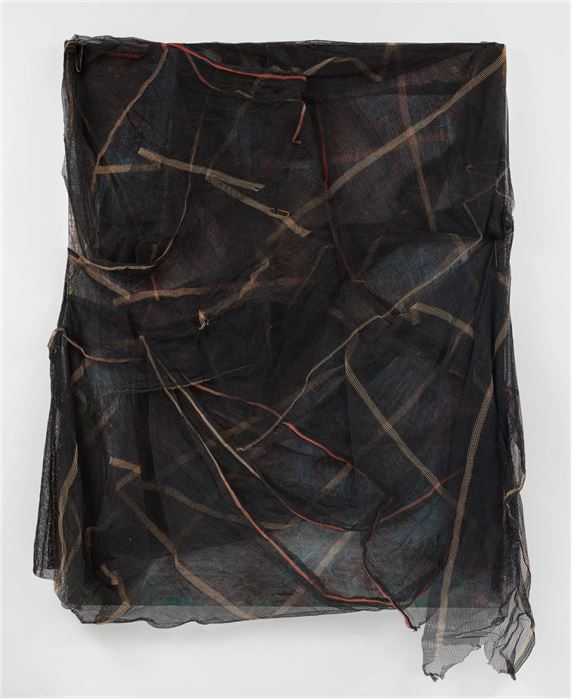
David Hammons, Untitled, 2014, acrylic and tarp on canvas. Courtesy of Hauser & Wirth and The New York Times.
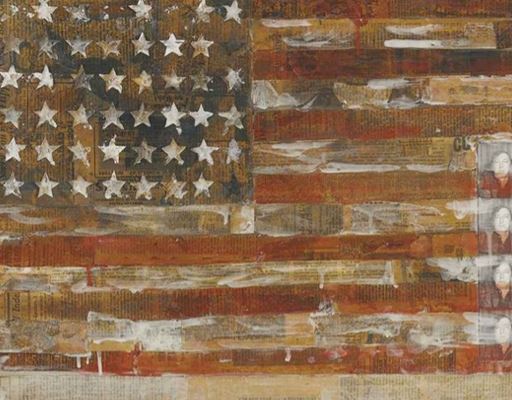
The first-day VIP previews kicked off Art Basel with the highest-priced sale of the week, David Hammon’s Untitled (2014), sold by Hauser & Wirth for $4.75 million, foreshadowing the prevalence of textile art this year. Other first-day sales were a mixed bag. There were some big names with exciting works, like Yayoi Kusama’s Infinity Nets (2017) which sold from David Zwirner for $3.5 million and a historic 1932 work on paper by Pablo Picasso from Vedovi Gallery for $600,000 – but notably, not his classic painting, Couple with Cup (1969), held at Acquavella, which was priced at $30 million (the most expensive piece of the fair) and not reported as sold. Weaker work from big names still fetched impressive prices, like three Keith Haring pieces from Gladstone, Ortuzar, and Pace, totaling $4.5 million and two works by Georg Baselitz from Thaddaeus Ropac, a sculpture for $2.6 million and a painting for $1.3 million. Furthermore, several historically significant but objectively tired works did well, like Sturtevant’s Flag after Jasper Johns (1967), also from Thaddaeus Ropac, sold for $1.1 million. However, strong work from undervalued artists like Etel Adnan, a key figure in Arab art’s Hurufiyya movement, had a piece sold by White Cube for $300,000, and Ha Chong-Hyun, the leading artist in Korea’s Dansaekhwa movement, who had two works sold by Tina Kim Gallery for $250,000 and $390,000. While the price tags may feel a little light compared to the opening day in 2023, when Hauser & Wirth sold Philip Guston’s Painter at Night (1979) for $20 million, there was more widespread success this year, and implications of shifting interests.
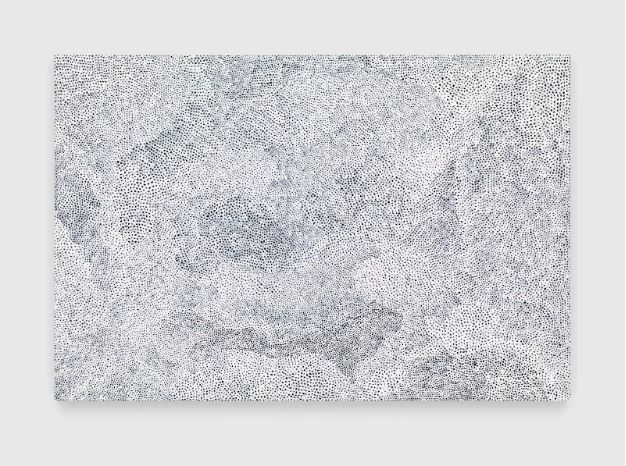 Yayoi Kusama, Infinity Nets, 2017, acrylic on canvas. Courtesy of David Zwirner.
There are some voices that will criticize a calm preview day, that somehow meandering collectors is a negative market indication and anything but a mad dash is suboptimal. I can’t help but wonder, When was the last time that happened? As I approach half a decade of fair coverage, I have not once seen the frenetic buying spree of legends. Even if there was a time when collecting had the energy of two women playing tug-of-war over boots on Black Friday, would that be a positive, favorable comparison? When art is bought for the sake of buying, quality control goes out the window and newer artists are left in the dust. We should be celebrating a thoughtful approach to acquisitions. Anyone that has been on the floor knows that there are often hidden works in a makeshift closet built within a gallery’s booth where hidden gems reside. In my experience, the only way to get invited truly unprovoked is to look like you have money, which isn’t always the case for advisors and representatives attending on behalf of wealthy clients. Otherwise, you have to rely on your interpersonal skills and articulate your intentions. That can’t happen if you’re sprinting booth-to-booth. If you ask gallerists their perspective, most were happy with early Art Basel sales. A metric from Thaddaeus Ropac was buzzing around the floor – their gallery “[hadn’t] sold this much off previews since 2022.” By the end of the week, Thaddaeus Ropac was one of at least three galleries with monumental seven-figure sales.
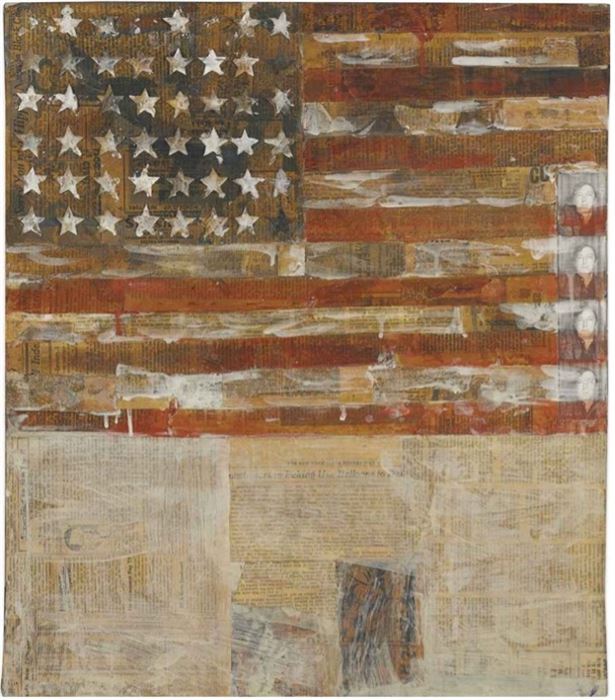 Elaine Sturtevant, Flag after Jasper Johns, 1967, photograph and wax on canvas.
A great benefit to analyzing a December fair like Art Basel Miami Beach is that on-the-ground findings can be cross-referenced with reports from the first half of the year (or H1 2024), like The Art Basel and UBS Survey of Global Collecting. Year after year, the US takes the lead in global art market spending, but China isn’t far behind. High-net-worth individuals (HNWIs) from Mainland China had the highest expenditure on art and antiquities all last year and in the first half of 2024, with a median spend of $97,000, more than double that of any other region. As a result, there was a strong presence of Asian artists this year. Across cultures, Gen X (people born between 1965-1980) have the highest average spend of any age group at $578,000 last year, extending their lead into 2024 with a low but steady growth rate of 3% year-over-year. The intersection of buyer region and age is a key demographic to cater to, inevitably influencing the works included at big fairs. While older generations tend to purchase work by Old Masters or traditional cultural works, younger generations have unique preferences that often parallel their sociocultural perspectives – these trends, which I saw on the floor in Miami, are supported by data from Daxue Consulting, which focuses on China market research. Gen X and below tend to prefer Western contemporary art, flocking to more modern booths, but younger collectors, like Millennials and Gen Z, are interested in the intersection of East and West. Their interest in contemporary work remains, but they often look for elements of their cultural heritage, whether that’s an Asian artist or an homage to traditional styles. In my experience, this is a trend I see often. Collectors across demographics have been looking to diversify their portfolios and support artists whose identities have long been underrepresented in the world of Western high art, but collectors who belong to those groups themselves tend to be most interested in art and artists that align with their respective identities.
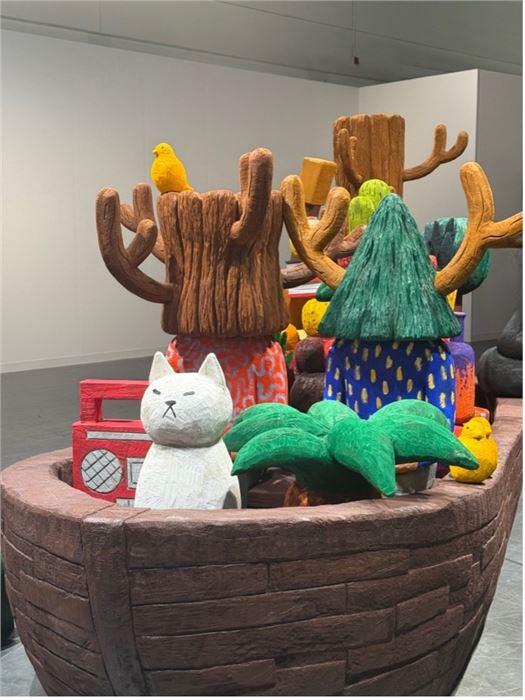
Yuichi Hirako, Seeding, 2024, acrylic on wood. Photo courtesy of Maya Garabedian.
One shift in the market that’s impossible to ignore is the rising interest in new mediums, an observation backed by Art Basel and UBS surveys. Paintings are still the favored medium of HNWIs, but that figure is declining: 81% of respondents in 2022, 80% in 2023, and 76% in H1 2024. People are also moving away from digital art purchases, declining 4% each year since 2022. Renewed interest in prints, multiples, and works on paper and a rising interest in non-traditional fine mediums best categorized as “Other Mediums” have clearly given dealers hope for a resurgence in sculptures and installations. Massive sculptures were at most big booths, many of which sold quickly, and textile art was around every corner – many of which fell short of standards one would expect at Art Basel, indicating that dealers expected high demand. These trends were seen at satellite fairs too. All 100 life-size elephants from The Great Elephant Migration, each weighing an average of 600 pounds and costing $8,000 to $22,000 sold out quickly.
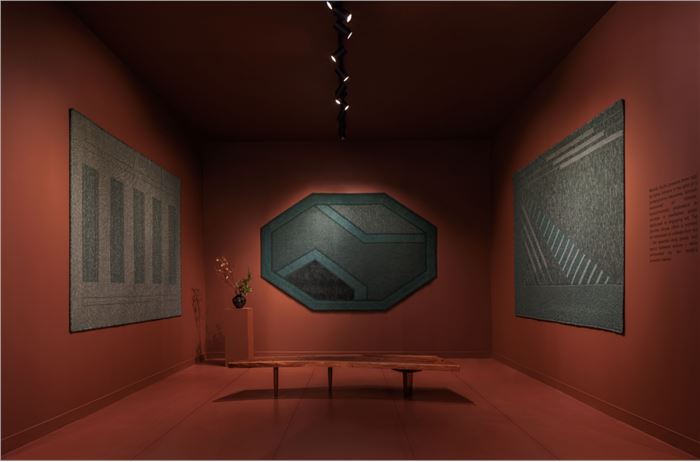 Sylvie Johnson’s Tokonoma exhibition room, 2024. Courtesy of Merida Studio.
At Design Miami, overwhelming favorites were textile-based works, like Sylvie Johnson’s solo installation with Merida Studio, in which she created a reimagined tokonoma (Japanese art appreciation space) with all yarn work from her Atelier Series. It’s safe to say that while paintings still reigned supreme this year, future fairs, particularly ones with high operating costs, will include an increasing number of “Other Mediums,” especially textiles, catering to a new kind of collector.
For more on auctions, exhibitions, and current trends, visit our Magazine Page