Amplifying Echoes: War and Art in Modern Ukraine
Art Shield empowers artists in war-torn areas, like Ukraine, by supporting their work, fostering cultural resilience, and promoting global artistic impact amid conflict
Abigail Leali / MutualArt
Jan 03, 2025
It’s an open secret that much of the greatest art and literature of the twentieth century came from men and women directly impacted by the two world wars and their surrounding tragedies. J.R.R. Tolkien suffered through trench warfare on the Western Front during World War I; it was there he began crafting the imaginative world that would become Middle Earth. Amid the bombing of London in World War II, T.S. Eliot served as a fire warden even as he was finishing his Four Quartets. And, of course, Pablo Picasso painted his masterpiece, Guernica, in 1937 to protest fascist atrocities during the Spanish Civil War.
There is nothing glamorous about war. It brings with it only violence, death, and – at the worst – the wholesale annihilation of people and cultures that used to thrive in peace. With our quick access to images, videos, and news updates by the minute, we today are more aware of the realities of conflict than anyone could have imagined in the past. The pristine, glorious scene presented by regimented armies parading out of town has long been usurped by security footage of grenade bombings and missile strikes – all too often aimed at civilians. But those of us lucky enough to encounter the horrors of war only from the safety of our living rooms have to remember: No matter how we may describe it, war is no stage, and these are no actors. Every statistic that flashes across the screen is a human life as real as yours or mine. Desensitized as we have become in the information age to “realistic” depictions of human suffering, perhaps it is time for a new generation of artists to take up the mantle and confront the world with the raw truth of their daily reality.
, Dark Unicorn, 2024.Jpeg)
Feros (Serhii Hrekh), Dark Unicorn, 2024
Art Shield is an organization that seems to agree. It was founded by Franco-British artist and actor Edward Akrout, who experienced the Revolution of Dignity while filming in Ukraine in 2013. Even on his own set, he witnessed fights break out between those who wanted to speak Russian and those who wanted to speak Ukrainian. When Russia’s 2022 invasion began, he returned to Ukraine – this time a blacked-out warzone. Edward Akrout’s pivotal moment came in October 2022 after heavy bombings in Kyiv. He witnessed audiences navigating dark, unlit streets with flashlights to reach cold, unheated theaters, where plays were performed under the flicker of candlelight. In that raw, resilient setting, Edward realized that Maslow’s hierarchy might be flawed – in times of crisis, art is not a luxury but a lifeline. This profound experience inspired the creation of Art Shield, a non-profit dedicated to nurturing and empowering artists under threat. Seeing how significant it was for people to find normalcy in something as mundane as a trip to the theater, which had been such a simple act in peacetime, he decided to do what he could to help.
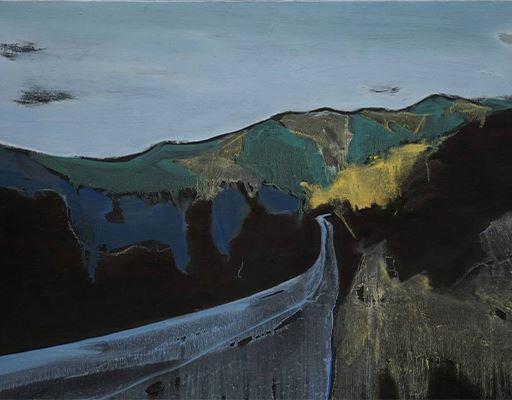
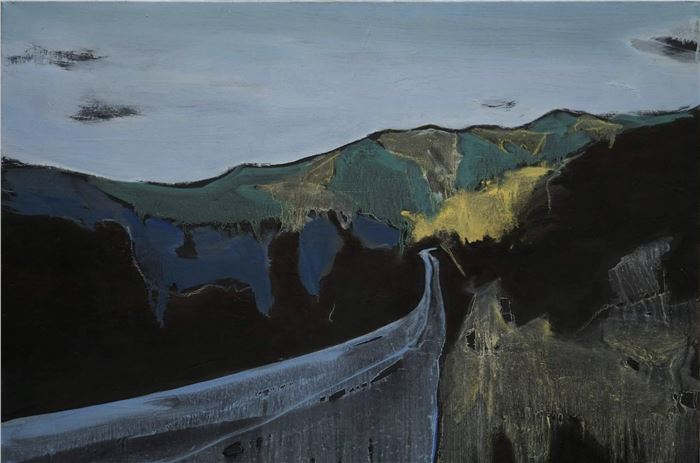 Oleksiy Belusenko, The road to Sudak, 2019
Art Shield aims to support artists living in areas marred by conflict and other hardships. They are in conversations with ten countries besides Ukraine, scattered across Africa, the Middle East, Asia, and North America. But they are selective with the artists they work with, looking for those who, in their estimation, have the talent, vision, and stamina to carve out a place in art history. Because areas like Ukraine have so long been pushed to the fringes of global culture by Russian colonialism and instability, they lack core systems and structures that help artists promote their work and develop a sphere of influence (think of institutions like MoMA in the United States). In fact, Ukraine’s cultural institutions were, in some cases, so underdeveloped that academics and journalists are forced to turn to Russian sources for information about the country. As one might expect, this does not contribute to an impartial assessment of Ukraine’s history and society.
This gap of knowledge and support is where organizations like Art Shield step in, providing assistance with press releases and promotion, as well as organizing exhibitions around the world. They recently hosted two Kyiv Art Sessions at the Old Sessions House in London, supported by their partner firm, Paradox Public Relations, which featured the work of around thirty Ukrainian artists. Fifty percent of every sale goes directly to the artist; twenty-five percent then goes to running the organization, and the final twenty-five percent to supporting the artist’s community.
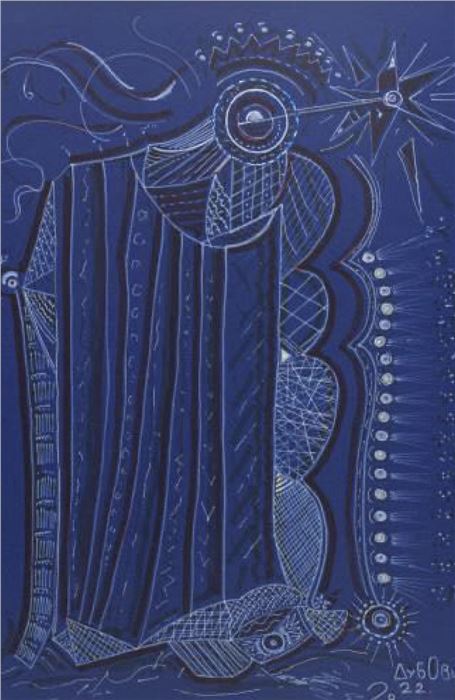
Oleksandr Dubovik, from Phantoms series, 2022
In addition to such events, they also connect with artists in Ukraine to organize projects that confront life during wartime – as well as the unyielding hope of the people who live through it every day. They are currently working on a documentary, Intermission, about Ukrainian actors who have temporarily abandoned their careers to fight for their country. Akrout, who is naturally familiar with the empathy and vulnerability necessary to act, was shocked when he initially heard about their experiences: How are they adapting to the most dehumanizing environment imaginable?
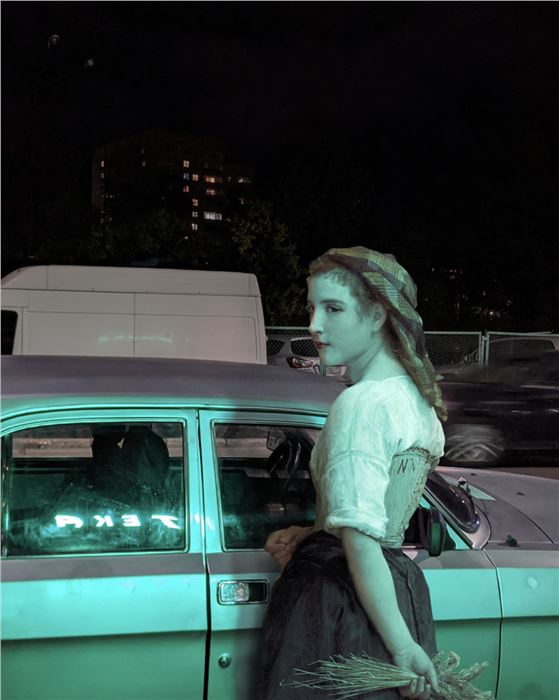
Alexey Kondakov, Green Light, 2020
Another Art Shield-supported project with a uniquely creative premise is Deocoupage. It began in the Ukrainian town of Izium, which was overrun very early in the war: around the time when the planting season for grapes had begun. When the city was finally liberated months later in September, Tetiana Burianova, a young translator with Human Rights Watch, was there to collect evidence of war crimes that had taken place in the area. She quickly noticed that every time she walked into a house, people would hand her grapes from their garden – grapes that had been harvested almost on the very day of their liberation. After some brainstorming, she started the Deocoupage project. Along with her team, she is turning the grapes of Izium into a wine of pain, hope, resilience, and liberation. One hundred percent of the proceeds go to Superhuman, an organization that assists soldiers and civilians with rehabilitation.
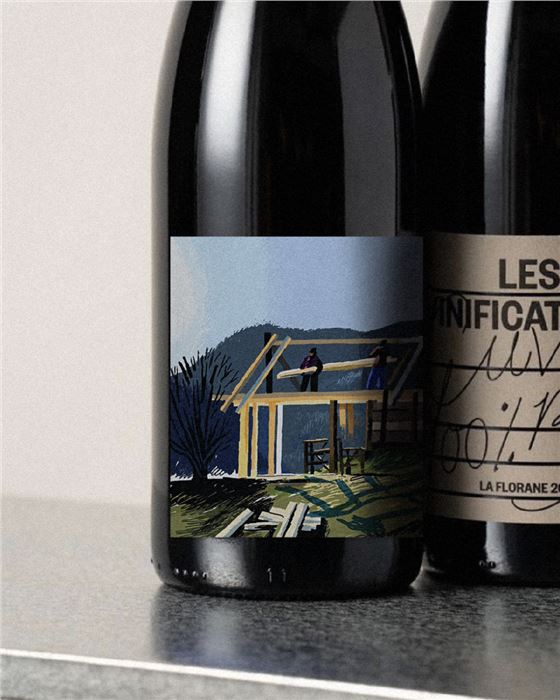
Deocoupage Wine
Each bottle of Deocoupage wine features a limited-edition piece of art on the bottle label from a Ukrainian artist, including from Gamlet Zinivskyi, a street artist who travels to recently liberated areas and even behind enemy lines to create activist pieces. He, like many others, has stayed in his hometown of Kharkiv despite heavy bombings.
Ultimately, it is people like these – like Gamlet Zinivskyi, or the Ukrainian actors sacrificing for their culture, or the silent members of battered communities who nonetheless welcome visitors with open arms – who continue to inspire and fuel Art Shield’s mission. Akrout admits that he will never be addicted the adrenaline of a war zone, as some have begun to wonder. War is a terrible thing. But he is addicted to seeing ordinary people rising to be heroes (as one of Art Shield’s own artists, Sasha Maslov, has been documenting in her photography series, “Saints”). With Art Shield, he has found a way to help them.
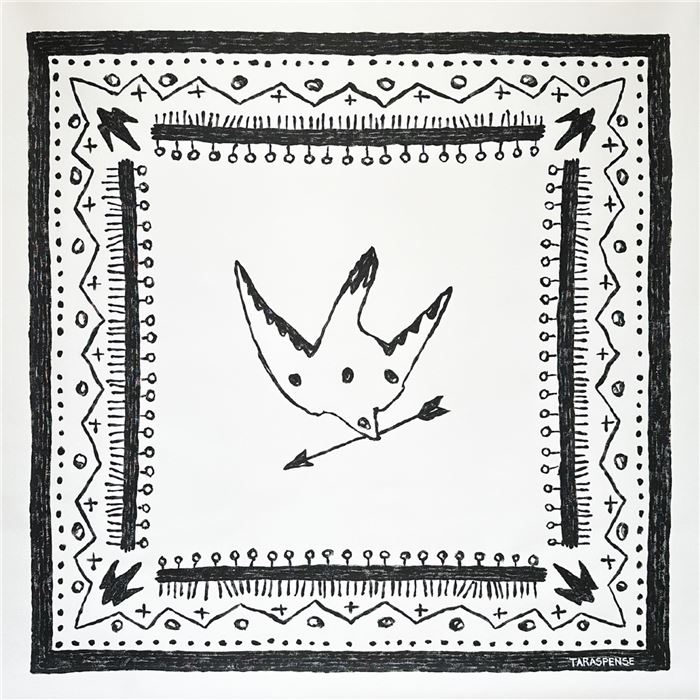 Taraspense, Fragments of Freedom, 2023
We are living in a time where artists in war-torn areas like Ukraine are faced with an existential question. Are we witnessing the last generation of Ukrainian artists or one of the most defining generations of European artists in the twenty-first century? Akrout, like many others, is hopeful. But even for those of us not wielding our brushes and chisels on the war front, there is room for us to help build the future of our world’s culture. “We live in a world shaped by great artists – and also shaped by great patronage,” Akrout says. “Patrons of the arts are just as important as the artists themselves.” While the idea of a “patron” may call to mind the great Italian families of the Renaissance or global institutions like the major world religions, the truth is that each of us, whatever our means, can consume with impact. Our support can bolster the next generation of Picassos and Eliots and Tolkiens – just as our parents and grandparents bolstered them. Art Shield is convinced, and so am I: Investing in artistic excellence, especially in our most vulnerable communities, will change the world.
For more on auctions, exhibitions, and current trends, visit our Magazine Page